The Medieval Calendar

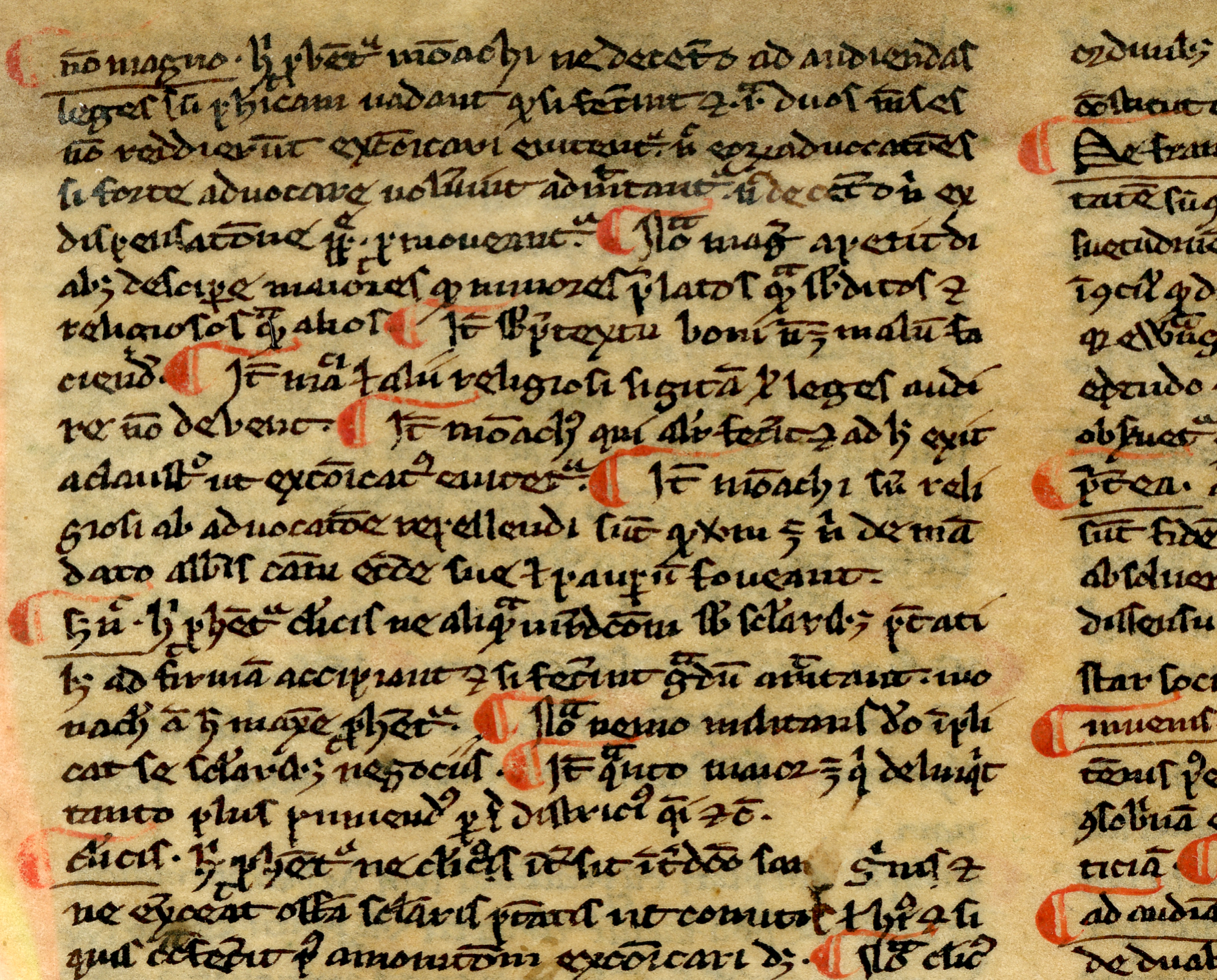
Medieval calendars are deceptively simple looking, but jam packed with potential information. They list events in Christ’s life and saints’ days (which occur on their date of death). My folio is a calendar for December, that takes up both recto and verso. Because of its size and the recto/verso thing, I believe it comes from a book of hours. I have been dedicating the majority of my efforts to transcribing and expanding the manymanymany abbreviations.

Liturgical manuscripts is a vast genre comprised of several different types of manuscripts with different functions. Books were written to serve specific purposes in Mass and in the Daily Offices and were arranged chronically according to the liturgical calendar, which had two cycles of time, the temporale and sanctorale. Calendars are most often found at the beginning of liturgical books, meant as an efficient means of identifying which events in Christ’s life and which saints’ days are celebrated on a given date. Many books in a liturgical library would contain calendars, especially missals, sacramentaries, and breviaries. The temporale, also referred to as the Proper of Time, is the basic church year, based on key events in Jesus’ life. In this cycle, the beginning of the year is 4 weeks before Christmas day on Advent Sunday. Christmas would always fall on December 25, Epiphany on January 6, Candlemas  etc. Easter was the high point of the church year as it commemorates the resurrection of Christ after the crucifixion. The date of easter changed annually, because the timing depended on the Jewish lunar calendar. Easter always falls on the same date as Pesach, which is celebrated on the first full moon after the spring equinox. The sanctorale, also referred to as the Proper of Saints, provides the information for celebration of saints’ days. Often the sanctorale began with the Feast of St. Andrew (Nov 30) and end with the feast of St. Catherine of Alexandria (25 Nov), mirroring the advent- to- advent structure of the temporale. It should be noted that especially important saints are celebrated for eight days, known as an octave. My calendar contains two- On December 7, “Oct(avue) s(an)cti andree” represents the end of the octave of Saint Andrew. December 6 begins the feast of Saint Nicholas (“nvcholai epi(scopus)) and it ends eight days later when “nichalii epi(scopus) is repeated on December 14.

Trying to wrap my brain around the medieval conceptions of time and calculating dates has been a lengthy and frustrating process. Medieval calendars most often used the Roman method of counting days, which has three fixed points throughout the month- Kalends (always the first), Nones (5th-7th), and ides (13th-15th). The days in between these three points are referred to as how many days until the next fixed day. So, since Nones occurs on December 5th, December 4th would be referred to as II Nones. The left side of the calendar contains two columns for the Dominical Letters and Golden Numbers. Dominical Letters refer to the day of the week, and are represented by the letters A through G. I initially assumed A always meant Sunday, but the way it works is slightly more convoluted. The dominical letter gets assigned to a year based on the first Sunday. So in a given year, if Jan 1 is a Sunday, the dominical letter  is A, and all As throughout the calendar would be Sundays, Bs would be Mondays and so on. But, if the first Sunday is Jan 2 the Dominical Letter would be B, Mondays: C Tuesdays D and so on. Knowing the Dominical Letter allows the reader to match the dates to days of the week, but you must know the Dominical letter assigned to the year.

To the left of the dominical letters are roman numerals known as Golden Numbers which show the day of the month on which the new moon will fall. These numbers are based on a 19 year cycle where the annual cycles of the sun and moon are reconciled. The Golden Numbers have the potential to be incredibly useful, however the reader has to know the current year, and what year in the nineteen year cycle the given year fell.

Can you believe I originally picked the calendar for its perceived simplicity???? I’ve played myself.
Inks and Pigments

As we near the end of term, our final Omeka catalogue entries are looming and the final pieces of our manuscripts are slowly being put together (figuratively of course). With this in mind, I came to the realization that my manuscript really has no provenance or origin that jumps up from the page in the form of a watermark or colophon. It was then brought to my attention in class that I will have to look at the ink and colours used in my manuscript – an incredibly taunting task to be performed, considering I am lacking in the history of pigments and inks. It was this that sparked the idea of this blog post; what do all these beautiful ink colours mean on these manuscripts and how did they come about.

I will not go into great detail over how the ink and pigments were made (as we have already learned about that), however as a quick recap: black ink was made from oak galls, and coloured inks were generally made from mineral pigments (red ochre, umber, yellow ochre).[1] Black ink made up the whole of the writing, with red ink (for which lead is the basis) for the rubric headings, though sometimes they appear in blue or green.[2] It is also noted that coloured inks were not only used for decorative purposes, but could be used to indicate a hierarchy of importance, such as saints’ names or feast days in a calendar.[3]

Upon further inspection of my manuscript throughout the semester, it is evident that it includes a lot of colour due to the miniature paintings that are located on the sides of each psalm. Along the edges of the text, and in the beginning initial of certain words, there is a metallic gold colour. The gold colour in most manuscripts is in fact not done with liquid pigment, it is actually made with “immensely thin sheets of beaten out metallic gold known as gold leaf”.[4] It was a tedious process that involved a brush that was used to apply gesso (plaster compound) so that the surface area of the page would be slightly raised, and then when dry it was smoothed and the gold leaf was applied with glue and sugar, to make it more adhesive.[5] Due to the skill, and money, needed to add gold leaf to manuscripts, it was usually something important that was being created, or someone with wealth (institution or patron) was commissioning such a piece to be made. Though, while my manuscript features lots of gold, there does not appear to be any raised surfaces where the gold is, which could indicate an older medieval manuscript if the gold initials were only painted on with a liquid gold suspension.[6]

While it is a difficult task to try to find out where my manuscript came from, doing further research definitely helps in trying to recognize certain aspects of medieval manuscripts that were done in certain periods. So, if you are ever stumped with trying to pin point the origin or provenance of your manuscript, look no further than the ink, pigments and style of writing!

Here are some further readings that offer way more detail into pigments and inks:

http://d-scholarship.pitt.edu/11954/1/a-baker-04-pigments.pdf

http://www.webexhibits.org/pigments/intro/medieval.html

http://exhibits.library.yale.edu/exhibits/show/making-the-english-ms/scribes-and-pigments

http://medievalwriting.50megs.com/tools/ink2.htm


Footnotes:

[1] Douma, Michael, curator. “Medieval Age (500-1400),” para. 2, Pigments Through the Ages, 2008, http://www.webexhibits.org/pigments/intro/medieval.html.

[2] Tillotson, Dianne, “Inks and Colourings (2),” para. 3, Medieval Writing, 2011,  http://medievalwriting.50megs.com/tools/ink2.htm

[3] Tillotson, Inks and Colourings (2), para 5.

[4] Tillotson, Inks and Colourings (2), para 11.

[5] Tillotson, Inks and Colourings (2), para 11.

[6] Tillotson, Inks and Colourings (2), para 14.

Preparing for the Final Omeka Entry

With the end of the term quickly approaching it is clear by the energy in class last Monday that everyone is feeling a little overwhelmed. This is a feeling that I am not impartial to. When I first read our Omeka assignments I began to worry about how I was going to finish my lengthy research papers for my other classes in addition to this large project. However, when you look at it more closely, the majority of the work required for this project has been completed, or at least partially completed, in the weekly exercises and in class workshops. If it was not completed, Marc has given us the tools to be able to complete it much easier than we would have been able to do on our own.

I am lucky and have been able to keep up with the weekly assignments and homework but I understand that is not a reality all the time. I have compiled a list of things that I plan to do this coming week in preparation for my catalogue entry and thought that I would share it as a blogpost in case anyone was looking for a starting point.

#1 – Go through the weekly plans on our class website here: https://medievalbook.gitbook.io/digitizing-medieval-archives/

While this does not give you all of the answers you will need in regards to your particular manuscript, it helped me to compile a list of important topics to cover. These topics include writing supports, paleography, abbreviations, codicology, and others. Making this list also helped to refresh my memory on some of our class discussions and reminded me of some important details that should be included in my catalogue entry.

#2 -Consult your in class notes

In this class I opted to hand write my notes and did not end up typing them out afterwards (something I always convince myself I will do every semester, yet never gets done). Every time we would discuss a topic relevant to my manuscript I would write it down in my notebook. This left me with a lot of very useful notes and ideas that I would lose completely if I do not go through my notes.

#3 – Consult in class handouts

A number of times during this semester Marc handed out some very useful reference materials in class that can be very useful to help your catalogue entry. Like handwritten class notes, the important information on these handouts is lost if you do not take the time to go over them again.

#4 – Skim over your textbook/readings one more time

We were assigned these readings because they are helpful and relevant to the topics required for our cataloguing. Skimming over them again may allow you to discover little details you forgot but can be added to your entry.

#5 – Browse various cataloguing databases

It is sometimes useful to view other databases to compare handwriting, or search for clues on your manuscripts provenience. In addition to these, catalogue entries found in databases can help to give you a clearer idea on what to include in your own work.

I hope some of this has been helpful! See you all in class.

Week 9: Codicology

Hello everyone and welcome to week nine with me, your host. Paige Bryenton. Codicology is the study of the physical manuscript and is apart of that process. When going over the material for this week, I did not realize how many different aspects go into the physical manuscript depending on its use. When looking over the readings for this week, Introduction to Manuscript Studies and Quick Guide to Liturgical Manuscripts, I found chapter 12 on manuscript genres in Clemens the most relevant to our course since most of us are dealing with liturgical texts and calendars. It is a good resource for more in-depth information on the the physical manuscript and what type of topics were written down. The Quick Guide to Liturgical Manuscripts is a useful tool in understanding more finer differences between different types of texts and is a great companion to Clemens.

The document


Some questions I would like to bring up is:

  1. When comparing the distinct letter forms discussed in the readings, which one was closest to letter forms we use today?
  2. a) What manuscript genre does yours fall under? b)What was its use? c) Is it a common document?
  3. Were the authentication methods used for charters effective?


What the %!@* are emojis?!

Automatically, when you read that title I am sure you filled in %!@* with your own thoughts, but what I really meant was “heck”. It is interesting to see how we have programmed our brains into reading symbols.

What the heck are emojis, and how do they fit into this medieval history class? Well, in the next 400 words or so,  I hope to bring some insight into this thought.

For me, transcribing my manuscript was extremely difficult. What I found even more frustrating was that we have endless resources online that could have assisted me (such as Latin abbreviations, alphabets and even guides on how manuscripts were written). Even with this resources, I was at a loss because I was not even sure what I was searching for. This got me thinking about emojis, and the language that we use every day. Are we documenting the meanings that we transcribe to emojis, and is that information even important enough for someone to consider documenting?

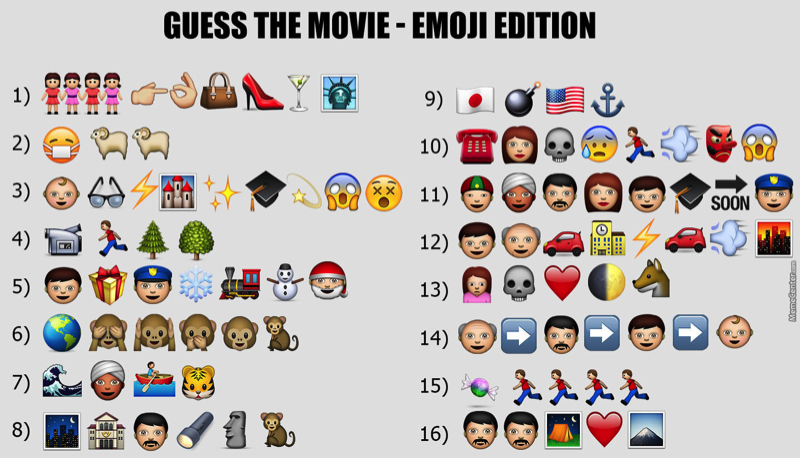
Let’s play a game. Take a look at these emojis and in the comments, leave your guesses to what movies you think that have been described in these emoji scenes. For us, this might be easy (or not). Imagine, however, in a hundred years (or longer), someone else trying to transcribe the meaning of the emojis. We have given emojis new meanings (the peach, and eggplant are just two examples of emojis that have new innuendos – not in this image, but in the context of texting now).

For example, the first one is the movie “Sex and the City” Image from: https://www.memecenter.com/fun/3287083/guess-the-emoji-movie

This is important to consider because our use of language reveals how our society reflects language. I would argue that we do not value language as much as those in medieval times did (or so I think that they did). We tend to skip words, ignore punctuation and add in images as often as we can. We limit ourselves to 240 characters or an Instagram caption. I do not think that we master linguists (honestly, I have no idea if linguists is a word and I think that proves my point), have decided that we can get our point across in as few words as possible, but rather I think we have become – lazy.

Emojis, can do the work for us. Just as abbreviations did the work for the monks who transcribed manuscript on manuscript. I think, their abbreviations were justified as they were probably sore from writing for hours as a day, versus us, taking one minutes (probably less) to send out a tweet.  It is important for us to examine how we use language in relation to how medieval manuscript transcribers used language. When we make parallels in our work, we will soon begin to understand their work better. I do not think that we are going to be finding any emojis in manuscripts any time soon, however, perhaps the emoji is the modern abbreviation (even more advanced than lol or rofl).

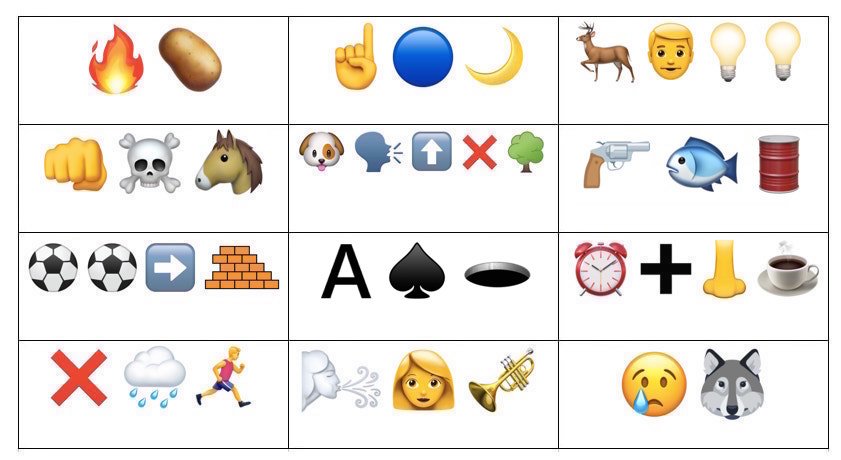
For your enjoyment, I have included a few emoji idioms to see if we can decipher what they say… Now we know how students in 3018 will feel deciphering our texts (if we live past clime change of course).

First one, “Hot Potato” Image from: https://www.sporcle.com/games/chaosBEE/idiom-emoji