A ‘Not-so-New’ Practice

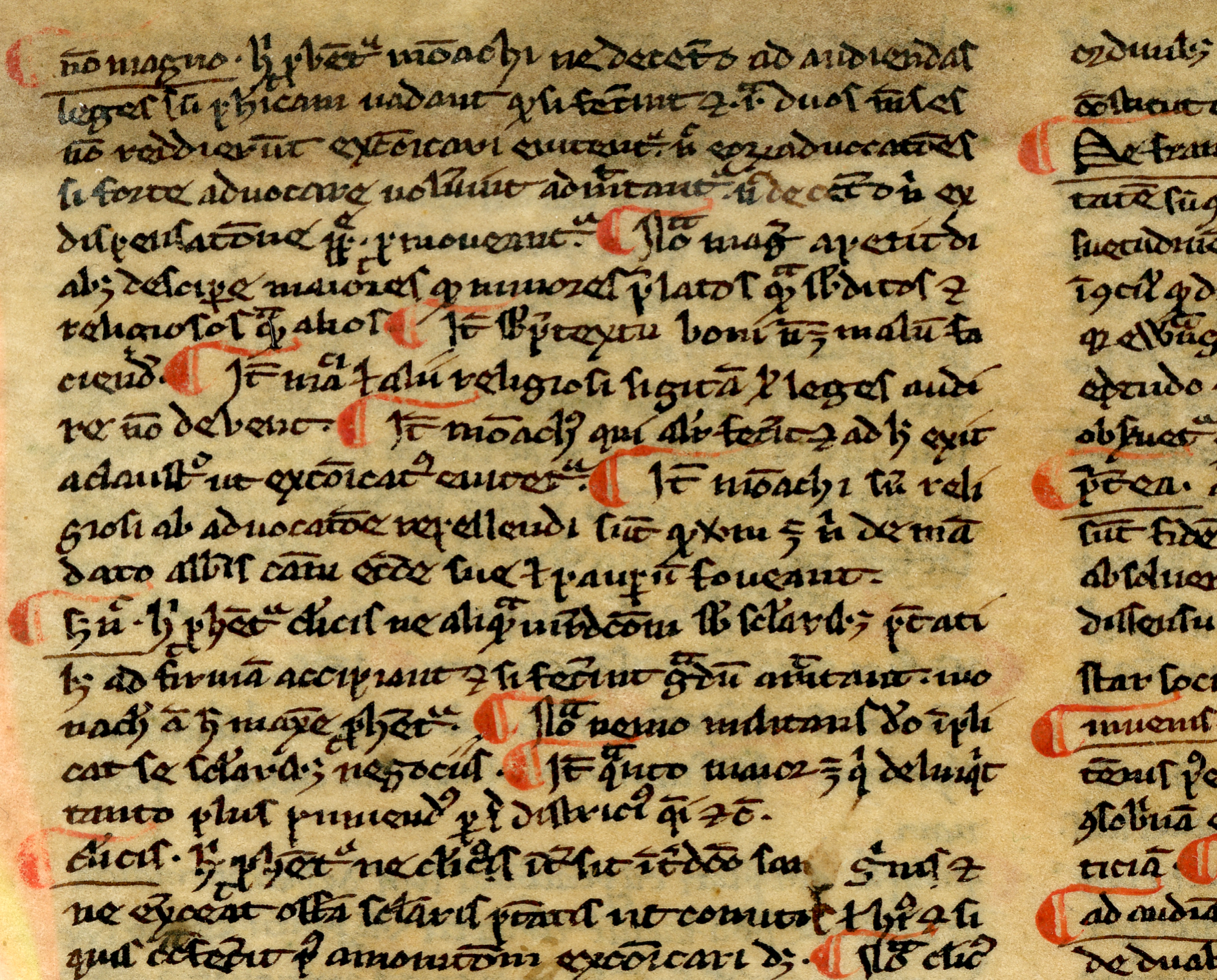
I used to believe that certain practices from the past were lost to current society as time moved on. For example, how often do you find a piece of paper today that has been made by hand? It came as a startling eye-opener then when I learned that the practice of shortening words to write quicker was not as new as I initially thought. Avid texters and tweeters should be made aware of the fact that, though the actual abbreviations change throughout history, part of the reasoning for this habit remains the same.

Prior to the ‘lols’ and ‘btw’ that currently dominate text messages, medieval scribes possibly used abbreviations to lessen the amount of time it took them to transcribe. Does this sound familiar to anyone? When you look at a manuscript with abbreviations there can be various dashes and amalgamations of letters (for example xpi and di) that represent condensed words. Also, as a student I often use punctuation to shorten words in my class notes (n. often stands in for the word ‘north’) because it means I can keep up with the professor. This is not an original idea or practice because Adriano Capelli notes this exact form of abbreviation in his dictionary on medieval abbreviations. With the realization that abbreviations are part of our history, ’lols’ and ‘omgs’ then signify the present generation’s role in the story of human communication.

For anyone investigating medieval abbreviations, they know that it can be a frustrating process. The urge to scream ‘what does this mean’ or ‘why would you write that’ indicates that what was once common knowledge to these scribes has disappeared over time. It is interesting to make a comparison between a modern historian studying medieval abbreviations and one who, centuries from now, investigates twenty-first century abbreviations. No doubt this scholar will experience a similar frustration considering how rapidly our abbreviations change. Furthermore, the understanding that ‘lol’ does not necessarily mean someone literally ‘laughed out loud’ is important contextual information future academics might not possess. This comparison demonstrates the importance of the context that lies in every abbreviation. I know that ‘g2g’ stands for ‘got to go’ because I grew up with this knowledge, just as a scribe might have known that ‘xpi’ represents ‘Christi’ because he transcribed it multiple times. Additionally, future historians will have a difficult time decoding our abbreviations due to the emotional meaning often lurking in our text messages. While sometimes I lament the task of decoding a medieval manuscript I certainly do not envy historians who examine twenty-first century abbreviation.

Abbreviations did not magically appear alongside the growth in texting. This is a practice with strong historical roots, evident in the presence of abbreviations in medieval manuscripts. Even students today who try to transcribe their professor’s lecture employ a technique these monks used, suggesting that the technique lingers as well. Next time I hear someone complain that texting words like ‘ppl’ (people) and ‘pls’ (please) signals the downfall of written language I hope this person is ready for an impromptu history lesson.
A Project Update From Emily

The last couple of weeks in our class have caught me largely off-guard. I knew going into this class with little digital or medieval knowledge that aspects of it were going to prove to be difficult for me. However, I largely underestimated just how challenging it would turn out to be. I even had to postpone my trip to Montreal over reading week to focus on preparation for leading my seminar (despite being on campus for more than twelve hours everyday working on it leading up to the day I was supposed to leave). In this blog post, I will highlight some things I am struggling with in the course, as well as sharing some aspects that I am thoroughly enjoying. Hopefully I am not the only one sharing some of these struggles.

I will start off on a more positive note with something in our course that particularly sparked my interest. Those of you who were in my seminar will most likely be familiar with the fact that I was very interested in the medieval pecia system. This is a system in which universities rent out piece, or copies of textbooks, to allow students to write their own notes to study from. These notes are called pecia. Our text mentions these copies were later returned or the students incurred a fine. As many of you know, I work in the Carleton library and this system particularly sparked my interest due to the many similarities it shares with the reserve service we offer. Professors can request material to be put on reserves for students to rent for short periods of time to study and take notes from. If the material is not returned by the end of the time allotted, the student receives a fine on their account. Though hundreds of years later, the fact that we still have a similar system in place in our own library interests me very much. The pecia system is definitely something, when time allows me to, I would like to do some further research on.

Something that I have found particularly frustrating thus far is the digital tools we are downloading and working on each week. Our professor (thankfully) gives very straightforward step-by-step guides to navigating through these processes. One would think this would make the process simple, but I still somehow find a way to make mistakes. This can normally be fixed by watching many YouTube tutorials on how to use the programs and eventually figuring out how to do the simple task that was assigned originally. However, this normally takes me much longer than it should have taken.

I also struggled with transcribing the first couple of lines of my manuscript. Even though I was leading the seminar on paleography and had read about the different practices in medieval writing, I still could not decipher the letters in my manuscript. This was particularly frustrating to me due to the fact that my letters had initially appeared to be relatively clearly written. I had checked out a Latin-English dictionary in hopes of deciphering the first two letters and then looking to see if any words in that section were close to my manuscript. This proved to be a largely ineffective process that was very time consuming and I do not recommend it to any of you. In class when Marc mentioned that medieval Latin is a bit of a free-for-all when it comes to spelling, everything made a little more sense.

I can go on for much longer about how difficult I found it to prepare for my seminar and how time consuming it is, but I touched largely on that in my last blog post which details some struggles I encountered in my preparations. So, I will choose to end this project update here. However, if any of you have any questions about preparing to lead your seminar that I did not touch on, I am more than happy to talk with you (as are your other peers who have led seminars, I am sure).

See you all in class!

Getting Reading for Week 7: Abbreviations

*This week’s blog post is brought to you by Veronica and Lynsay*

This week we’re looking at abbreviations! Though many people today use abbreviations when sending messages over text, few might realize that shortening words isn’t actually a new practice. These readings will examine the use of abbreviations (and punctuation in the case of Intro to Manuscript Studies and Shady Characters) across various regions in Medieval Europe. The textbook introduced us to some new Latin words as well; distinctiones, positurae and a few other Latin phrases thrown around. Latin does not come naturally to me, so it tends to take longer for me to grasp the definition of certain Latin words. Here’s a quick reminder of those two words (because if I was reading this I would have had no clue what those were from the top of my head):

 Distinctiones: single points (punctus) that were placed at different heights to indicate different pauses while reading.

Positurae: a system that showed the reader how they should use their voice while reading (higher, lower, emphasis) using different punctus.

  • In what situations might abbreviations be preferable? What are the benefits and disadvantages for historians when looking at manuscripts that use abbreviations? What are the possible ways to overcome the challenge of understanding/transcribing abbreviations?
  • Much like the style of text abbreviations seems to vary across different regions. What might account for these differences? Why weren’t they just universal? Have you noticed during our time any differences in abbreviations across countries or regions?
  • Take a look at your own manuscript. Can you see any abbreviations or punctuation? Do they look like any of the examples provided in the textbook or are they their own alien punctuation?
  • Why do you think abbreviations were different depending on the region (Latin regions that is)? Why weren’t they just universal?
  • Not so much a question, but the third part of the Emoji article was published on October 14th, so I recommend taking a look: https://shadycharacters.co.uk/2018/10/emoji-part-3-go-west/


Expanding and comprehending abbreviations can be a frustrating process but it provides another piece of the puzzle when historians try to understand medieval manuscripts. The next step is trying to share what we know about abbreviations with the wider public in a way that does not come off as dry and boring. Also, we need to find a way to share what we know about abbreviations to help further academics with their transcriptions down the road. As you read think about ways we can share with others (both academics and the wider public) our understanding of medieval abbreviations.


Notes on Leading a Seminar

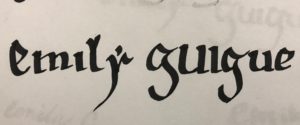
This Monday I was in charge of leading our seminar on medieval paleography. Leading up to the seminar I was very nervous. However, once the discussion began I was able to quickly get over my nerves. Everyone seemed prepared and discussion came easily (I am very thankful to you all for this). Some of you shared answers to questions that I would have never thought of. It made me realize just how important our collaboration in this class can be. Towards the end of class we even got to experiment with different types of writing instruments which was very exciting. I have displayed above my attempt at writing some early gothic script – it was much more difficult than I had anticipated.

Some things I found helpful for preparing to lead my seminar: I had done the readings ahead of time and had copied out important details with the page numbers they could be found on. This left me with a detailed outline of each individual reading. However, I ended up with ten pages of notes. I know that in order to explain all of these points I had highlighted I would have had to talk for far too long. I then went through my notes and highlighted and annotated topics that I thought would be relevant to our discussions. I used these key themes to base my discussion questions around. Surprisingly, most things that I had included on these ten pages came up anyway, through discussion. Which led me to conclude that when highlighting key points in the readings during your seminar you should not aim to highlight everything but instead aim to spark discussion that will reveal important topics. Your classmates have all done the same readings and are knowledgeable on the same topics so if they are relevant there is a high likelihood they will come up. If not, you can guide the discussion in that direction.

Even though my seminar leading experience ran relatively smoothly, I have an idea of some changes I will make for next semester. I intend to begin preparing for my next seminar over winter break as it is a very tedious and time consuming process (much more so than I had anticipated). I also intend to integrate my questions into my short discussions of each text. I will do this to a) avoid talking alone for a long period of time and b) allow more time for discussions.

Thank you all for your interesting contributions to our discussion this week!

Medieval Paleography

Good evening students of HIST 4006 (and anyone else who happens to check this blog),


Tomorrow I will be leading our seminar on paleography, or, researching and dating changes in writing patterns and practices. I am nervous to lead this seminar but know that I am in a classroom full of supportive peers. For this class we are expected to be familiar with five separate chapters.


The first chapter comes from the textbook and details the different types of text and decoration that are present in manuscripts. It begins with detailing the tools that are used such as the parchment, penknife, ink, etc. It provides some instructions for making ancient ink as well. It explains the different stages of copying and the set up a monk would have when writing manuscripts. One particularly interesting part of this chapter is the pecia. This is a system used in early universities where a copy of the required text was rented out to students to allow them to make their own copies and then returned after completion.


The next chapter we are required to read for this class also comes from our textbook and outlines the correction, glossing, and annotation process in medieval manuscripts. It details how corrections were done when the manuscript was complete and provides examples of types of corrections that are made. For example, the most common mistake, the ‘eyeskip’ was when a monk missed part of a manuscript when copying. These mistakes were scraped off using a penknife and the corrections were made accordingly. This chapter also details how glossing became more complex during the period of study (12th century onward). Various annotations were also explained in this chapter such as finding aids, line fillers, pen trials, etc.


The third reading for this class is also from the textbook and details how to differentiate and date various types of text found on medieval manuscripts. It explains the transition from quadrata which begins and ends with diamond shaped serifs to semi-quadtra, praescissa, and eventually rotunda in which all text is all upright and angular. This chapter shows different scripts and provides some clarification for letters that are biting and/or different than we would expect.


The fourth text is written by Kwakkel and focuses on the dating and evolution of Caroline minuscule script to gothic by examining different ‘feet’. This was a shift that he argues occurred from the 11th to 13th centuries. He explains that change most likely originated in small influential groups before becoming so widespread. He details the shift from caroline minuscule to gothic and some of its chrematistic changes including narrower letters, fusions being introduced, more angular appearance, etc. Through the analyzation of over 300 manuscripts he was able to somewhat track the progression of this change, believing it to have originated in Normandy.


Finally, the last reading for this week was by Wakelin. His article focuses on the evolution of how writing books evolved over time. He explains how time consuming the process copying manuscripts was and explained that this was carried out on top of a large number of tasks monks were expected to complete daily. He explains how at the time there was notions of what script was acceptable for certain writings. He too discusses the changes that occurred with the shift to gothic script, mainly the thick vertical lines and thin horizontal ones, as well as the introduction of biting. However, he focuses on the adoption of cursive as well. This was a practice that was adopted from the late 13th century onward and was most likely the result of wanting to improve productivity rates. Cursive allowed the monks to work faster and thus produce manuscripts cheaper. He explains that the more time consuming writing was the more important it was. Even with the introduction of cursive, works of importance often continued to be written in the more time consuming gothic script.


Some questions to consider for class:


  1. What can historians learn from the fact that different processes of the manuscript were carried out in different locations by the 13th century? Ex. The script was written and pages were sent elsewhere for images to be added.
  2. The pecia university system that allowed students to rent books in order to write their own notes functioned somewhat similarly to our library reserves system. Students could borrow books to learn from and make their own copies but were fined if they failed to return them. What can this tell us about the importance of notetaking in the medieval world? Do you think we are still learning in a similar way?
  3. Some manuscripts were illuminated with gold. This process would require the patron to pay for the metal itself and the time of a metalworker in addition to a scribe. What does this tell us about the importance placed on manuscripts in the 13th century?
  4. Some shifts in writing patterns such as caroline minuscule to gothic happened most likely, as Kwakkel mentioned, due to a small group of influential scribes making a change that spread. If it does not speed up the writing process, what is another reason this script may have caught on?

I hope you all enjoyed your reading week and I will see you in class tomorrow!