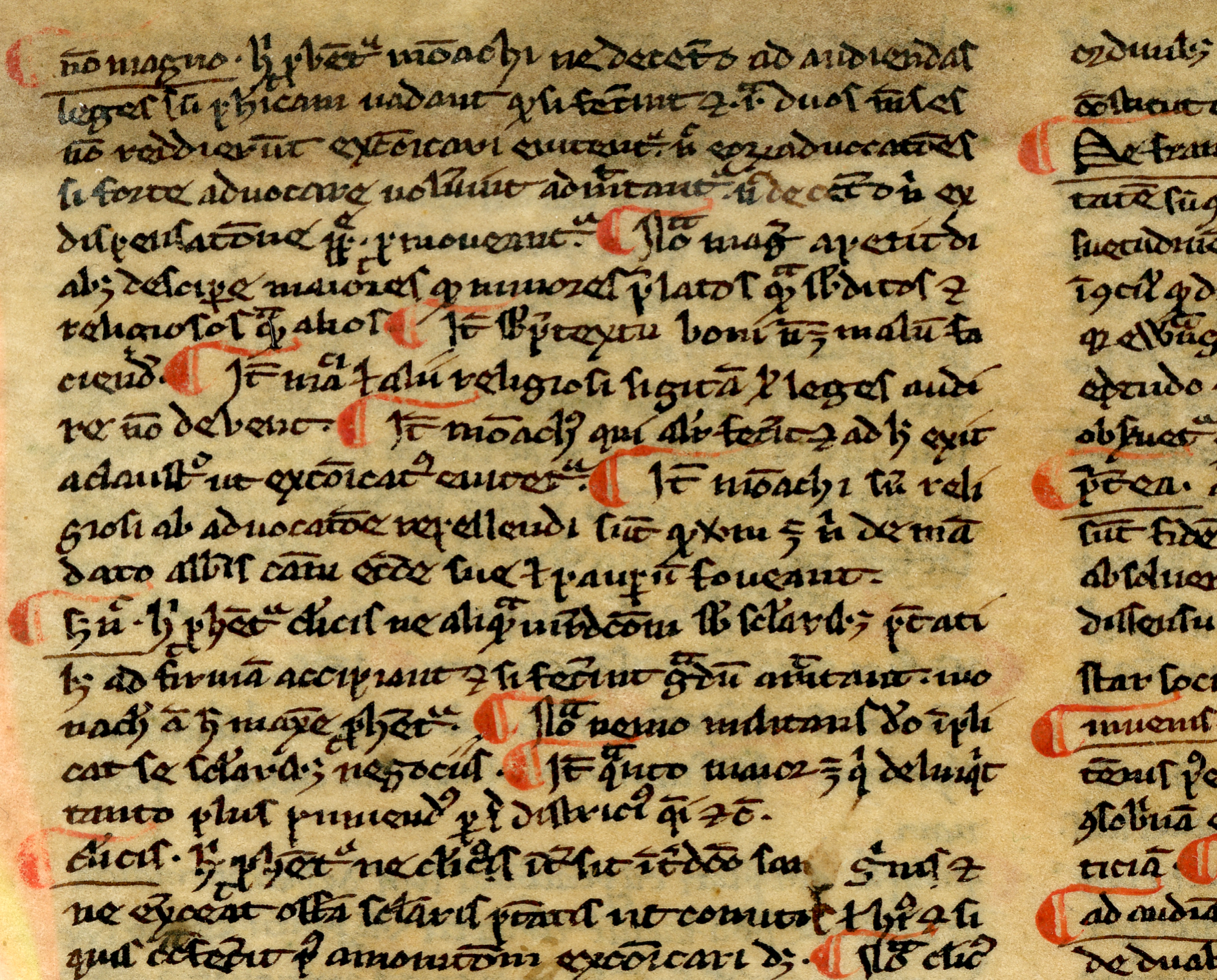
Monks, Scribes and Transcribing… Oh My!

This week in class we began the increasingly tedious task of transcribing our medieval manuscripts. One might think “oh well, this must be easy, all I’m doing is copying what I see in front of me!”. To a new transcriber, that thought is so wrong, so very, very wrong. Medieval Latin has this “amazing” thing where it uses unfamiliar abbreviations, sometimes there are no breaks in sentences or words and occasionally the letters do not look how they do in today’s modern alphabet. It took me an hour to transcribe 3 short lines of my manuscript, and there are definitely some questionable words I have created, due to the fact that I cannot decipher the correct letters and/or spelling. While this process is ridiculously frustrating, it is also incredibly fascinating (if you like this kind of stuff, that is). While I spent my time trying to configure my 3 lines, I came to think: “if I’m struggling with 3 lines, how on earth did monks copy/transcribe whole volumes of books?!”.  It wasn’t as simple as copying line per line; most of the time Latin was not the first language of monks (depending on where they were from), so copying Latin texts was no easy feat – or even if they spoke Latin flawlessly, a lot of texts were in Greek as well. This all lead to my final question, how or why did monks transcribe? Where did it begin? So I did some further research to find out.
I came across a fantastic website from Dartmouth University called Dartmouth Ancient Books Lab, which offers historical background on paleography, codicology and papyrology.  The specific article I looked at is called Medieval Book Production and Monastic Life, which explains the origins of copying texts. It all began with an Egyptian Christian named Pachomius who believed that all monks should be literate, and then some two hundred years later a man named Benedict established an Italian monastery called Monte Cassino.[1] From there, Benedict created guidelines, which he called Rule of Saint Benedict, and describes what the daily routine of a monk should be (which included tons of reading).[2] Soon after, copying texts became part of a monk’s life, due to a man named Cassiodorus’s Institutes rule book.[3] Monks believed that copying texts, especially biblical texts, were a way to spread the word of god and to fight the “snares of the devil”.[4] They often worked grueling hours, especially if they were particularly skilled at copying texts, which could lead the monks to feel anxious, hopeless and apathetic.[5] This was known as acedia, or as we know it today, depression (I mean who wouldn’t feel these things after sitting hours and hours a day inside with little to no conversation).
Not only was the copying and reading manual labour, there were also some issues that arose with it. For one, human error is inevitable, so words were spelt wrong, miscopied, forgotten or skipped on purpose (or sometimes even entire lines were just eradicated from the copied text).[6]
There were so many difficulties that a monk faced on a day-to-day basis, it’s hard to believe that people worked with these conditions. After writing this post I definitely feel I got the better end of the stick then the monks, and I’ll have to remember that copying my 13-line manuscript is not as grueling as a monk’s work!

If you want a more detailed explanation of a monk’s work, then check out these websites: https://sites.dartmouth.edu/ancientbooks/2016/05/24/medieval-book-production-and-monastic-life/

http://ultimatehistoryproject.com/the-medieval-scribe.html

https://www.khanacademy.org/humanities/medieval-world/medieval-europe/a/medieval-manuscripts


[1] Victoria Corwin, “Medieval Book Production and Monastic Life,” para. 1, Trustees of Dartmouth College, May 24th 2016, https://sites.dartmouth.edu/ancientbooks/2016/05/24/medieval-book-production-and-monastic-life/

[2] Corwin, Medieval Book Production and Monastic Life, para.1.

[3] Corwin, Medieval Book Production and Monastic Life, para.1.

[4] Corwin, Medieval Book Production and Monastic Life, para.1.

[5] Corwin, Medieval Book Production and Monastic Life, para.2.

[6] Corwin, Medieval Book Production and Monastic Life, para.3.


A late introduction (blog bio)

Greetings, my name is Ian Kerr and I am a history major with third year standing, and I am currently in the process of earning my BA Honors degree. I’ve always been extremely interested in Ancient history and ancient societies such as Ancient Greece, Rome and Ancient Egypt to name a few. However, one of my main passions ever since I was a little kid was my fascination with the middle Ages, particularly the culture and the imagery associated with the era Knights, Kings, Queens, Bishops and so forth, and as such I’ve always wanted to learn more about the era in general. I chose this course because it seems like one of the best opportunities I will ever get to learn about this culture and actually interact with pieces of medieval history first hand, as well as being able to analyze and discuss them, so I am very excited to be taking this course. Some random things about me are that I have a Siamese cat named Benkei (named after the Japanese warrior monk folk hero, who according to legend held a bridge against 20-40 enemy soldiers in one of the most memorable epic last stands in history. Another random thing is that I really enjoy video games, particularly any strategy or fantasy games, such as World of Warcraft and StarCraft 2 or the total war strategy game series. Overall, I am really looking forward to taking this course throughout the year, meeting all of you, and of course learning some really neat stuff about the middle ages.

Why I love the Middle Ages

Ever since I was a little kid I have been fascinated and intrigued by the culture and imagery associated with the Middle Ages. I believe the thing that started my interest in the culture was the film “A Knights tale” starring the late Heath Ledger released in 2001, as a kid, I absolutely adored this film, and although of course it took a more Hollywoodesque approach, I loved how it depicted the culture and society of the Middle Ages, the knights, squires, kings and Queens, and of course, jousting. I loved seeing the different knights hailing from different noble families, each with their own colours and heraldic symbol representing their house, it really got my imagination going as a kid, and every since I saw that film I know I have wanted to learn as much as I can about the period.

This film is also what started my great interest into medieval fantasy such as Lord of the Rings and later Game of Thrones, as well as fantasy games that depict an almost dystopian Middle Ages such as the Dark Souls series, and ones will a more light hearted approach such as World of Warcraft.

So all in all I am super exited to be taking this course because that means I get to learn more about this incredibly interesting period as well as look over actual historical artifacts preserved from this period, it is honestly an incredible opportunity and a dream come true. It honestly kind of blows my mind that we even have access to these historical artifacts not to mention permission to touch them, which reminds me that I need to be less sleep deprived and very careful when I handle such artifacts in the future as to avoid furling the edges, and possibly damaging them. Although, I am currently having a hard time completing and navigating some of the more technical aspects of the course, such as the humanities commons site as well as some of the other sites, I am looking forward to being able to navigate these sites with eventual ease and am thankful I am learning them now, as having accounts set up and knowing these services might be very helpful going into my last couple years of University. All in all I am very much looking forward to learning a combination of technical as well as analytical skills, and just simply having fun and learning about the Middle Ages in this course.


Preparation for Leading a Seminar

This week I got to dabble in the art of “leading a seminar”. Perhaps in the medieval times we would have had wine to enhance this conversation… (I actually know quite little about medieval history so if that is inaccurate I apologize – this perhaps will be my tragic flaw but only time will reveal that). My knowledge does however extend to seminar leading and Github.

This week we looked at open source notebooks, their implications, barriers and how we can directly apply this to our class. I decided to put together some tips for others leading a seminar on things that I did that I found useful and useless.

Useful

– Do the readings twice. Read them the first time to make notes and raise questions (as if you were not leading the seminar). The second time around, read them and think about what material left you with unanswered questions. Or think about how to relate the article to that week’s discussion.
– Review the readings once again prior to the lecture. I did the readings a week in advance and had to review them the morning of to make sure I remembered everything.
– Take notes on Hypothesis. Hypothesis (although can be horrible) has it perks – my personal favourite is that I will never lose my notes. As well when others are doing the readings they can see what you are thinking about. As well, if you highlight the important parts then people are more likely to read those sections.
– Create your broad questions for discussion and post those. Then on your own time, make questions that are “lead-offs’. These are questions for when nobody responds, you can ask this question and perhaps it will trigger their minds to think about the topic differently.
– Answer your own questions. Not everybody will be talkative so make sure to bring your own ideas to the table.

Useless

– Making more than 5 broad questions. More often than not, you will find yourselves deep into conversation therefore creating more questions than necessary isn’t always the best. (I mean the ones you post, not the specific lead-off ones).
– Doing all the work. You want to make sure that you are not the only doing the readings for the week. You are definitely leading the seminar and making sure there are no silences but you want to make sure everyone isn’t piggybacking off of you. After all, we are working as a team.

I personally really enjoyed leading a seminar. I tried to ask questions that I knew would A) stir the pot and get discussion going and B) that would get people thinking. A lot of the questions that I asked were designed to have many different view points and answers. I wanted to make sure that I was limiting my own bias and allowing people to have a space for their own opinions. I think a topic like open source notebooks is hard because there are not really any right or wrong answers to this topic. It is still something that we are learning about even now. It will be definitely interesting to see how are topics evolve as we get further into our own projects and into the class.

A Whole New World

Prior to my first year in university I remember various high school teachers cautioning me about laptop use in the classroom. “You’re in the Arts, you don’t need that computer for much” they said, installing in me a belief that Arts students should only use their computers for research, essays and nothing more. Flash forward to fourth year where I learned that the digital world can benefit Arts students as they use online platforms to share ideas and work together on projects. Although this will be a gradual process presenting certain challenges, students who engage online with one another (for educational purposes) expand their understanding of what it means to be in academia.

My university experience largely consists of various one-way exchanges with professors in which I research, outline an argument and then hand in an essay for a mark. When I read about academics using open source notebooks to share their research it came as a startling revelation. It turns out that my research process and essay crafting has the possibility for a much more dynamic life. In articles discussing the academic use of Github and Twitter, the imaginary wall existing between the online community and university students shattered. Through talking with classmates on Slack and ‘following’ scholars on Twitter I realized that there is a community out there (potentially) interested in my academic pursuits. Or, at the very least, this community can point out inconsistencies and errors along the way.

It will take a while before others scholars share the view that students should interact with academics on Twitter and collaborate on projects through online platforms. Unless a course focuses explicitly on digital humanities or the professor is an avid spokesperson for online platforms, Arts students will not discover their place in the digital world. There is still too strong of a belief that Arts programs should not go anywhere near platforms used by computer science majors. Until students consistently use online platforms for academic purposes, the barrier between the Arts and the digital world will remain stronger than ever.

For students to benefit from online academic engagement they must first be able to access these resources. If we want to encourage students to use online programs is the onus on educational facilities to provide laptops or tablets for everyone? If universities decide to provide these resources will it increase tuition? I can say that students should use their laptops to work together along but I speak from the privileged assumption that everyone has to access a computer.

Using online platforms to share ideas and research as well as social media to observe interactions between academics expands my understanding of how one can learn. A history degree does not necessarily exclude me from learning about Markdown or Github, instead I can develop my research through these (initially) computer-science based programs. For all those high school teachers warning Arts students about computers in the classroom rather than contributing to this barrier they should consider the positive side to embracing technology and the digital world.